HELOC vs. Second Mortgage: Why the Right Tool Matters
"Isn't a HELOC just a second mortgage?" It's one of the most common questions I hear, and it's a fair one. Both can use your home as collateral. Both can show up on the same line of your credit report. But they behave very differently, and that difference matters a lot when your goal is to get out of debt faster.
A second mortgage (home equity loan)
A traditional second mortgage, often called a home equity loan, works like your first mortgage:
- You borrow a lump sum up front.
- You pay interest on the full amount from day one.
- You make fixed monthly payments for a set number of years.
- Once you pay money back, you can't borrow it again.
That can be useful for a one-time expense. But it's just another installment loan, and it doesn't help your income work harder.
A HELOC (home equity line of credit)
A HELOC works more like a checking account with a credit limit:
- You can draw money when you need it and pay it back when you can.
- Interest is usually charged only on the balance you're using, often calculated daily.
- As you pay it down, that room becomes available to use again.
That flexibility is what makes a line of credit a useful tool in Credit Line Banking. When your paycheck lands, it can go straight to work lowering a balance instead of sitting idle, while you keep access to money for your regular bills.
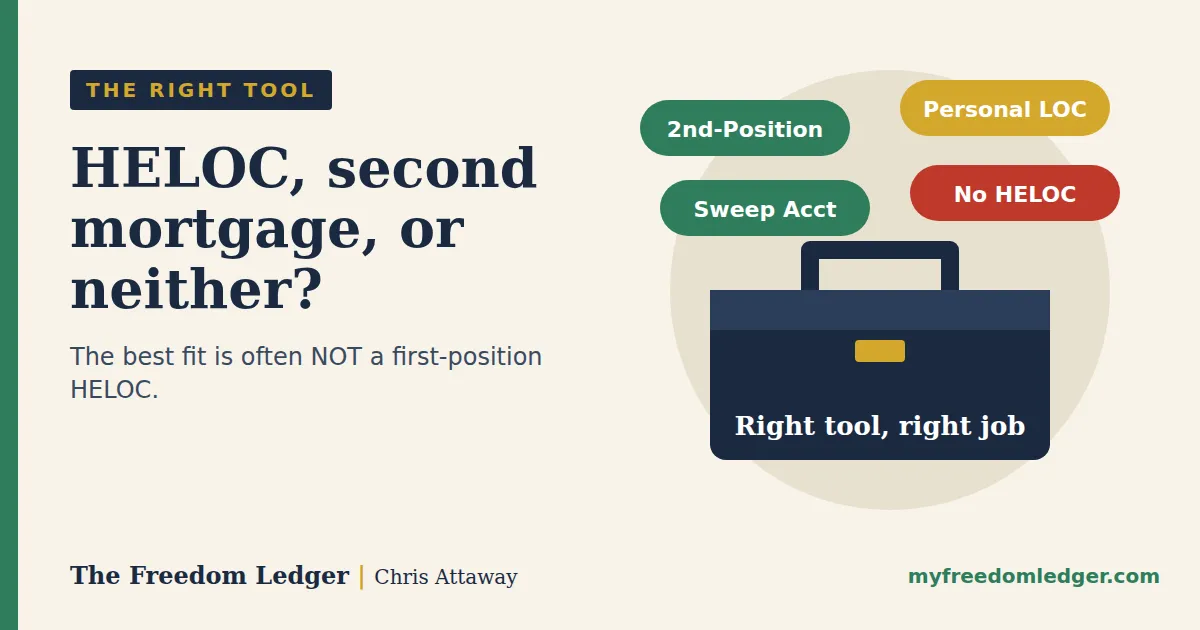
First position, second position, or no HELOC at all
Here's where many people get stuck. They hear about velocity banking, assume it requires replacing their mortgage with a first-position HELOC, and either don't qualify or don't want to give up the fixed rate they already have.
The truth is, there's more than one way to do this. Depending on your numbers, the right fit might be:
- A second-position HELOC that sits behind your current mortgage, so you keep your existing rate and terms.
- A first-position HELOC with a sweep account, for some homeowners whose situation fits it well.
- A personal line of credit (PLOC), which doesn't use your home as collateral. Limits are often smaller and rates may be higher, but it can still be an effective tool.
- No HELOC at all, when another approach fits your income and goals better.
In many cases, the best option is not a first-position HELOC. If you already have a good fixed rate, replacing it may not make sense. That's why the process starts with your numbers, not with a product.
How to think about which tool fits
A few questions shape the answer:
- How much equity do you have in your home?
- What's your current mortgage rate, and do you want to keep it?
- How steady is your household income, and how much is left after expenses each month?
- How comfortable are you with a line of credit and a simple monthly routine?
There isn't a single right answer. There's the right answer for your family.
See what's possible with your numbers
Every family's situation is different. In a free 15-minute call, I'll ask a few questions about your mortgage, income, and goals, and tell you honestly whether a deeper look makes sense. No pressure, no obligation.
Book your free 15-minute call or call or text me at 386.346.2683.
— Chris Attaway, The Freedom Ledger
This article is for educational purposes only and is not financial, tax, or legal advice. Examples are hypothetical and for illustration only. Results depend on your individual situation. Consult a licensed professional before making financial decisions.
